Fine Pruning: Tree Pruning & Crown Shaping Specialists
Healthy trees do more than frame a property, they anchor soil, shade living spaces, cool streets, and provide habitat. The flip side is real, too. Unmanaged crowns scrape roofs, block sightlines, and fail in storms. Fine pruning sits in the middle ground, the craft that keeps trees vigorous and safe while preserving their character. It is not a haircut, and it is never topping. It is a sequence of decisions about structure, biology, and aesthetics, carried out with a pair of clean blades and a good eye.
What fine pruning really means
Ask ten people why they want a tree pruned and you will hear ten answers. More light on the patio. Off the wires, please. Can we save that split limb. A better silhouette from the street. Fine pruning meets these goals without weakening the tree. It blends crown cleaning, thinning, reduction, and selective shaping, guided by species biology and site context.
A strong prune respects a few limits. We follow ANSI A300 standards for tree care, and we rarely remove more than 20 to 25 percent of live foliage in a single visit. Cuts land just outside the branch collar, not flush. Target branches are chosen for structure and long term balance, not short term convenience. If reduction is called for, we drop weight to laterals that are at least one third the diameter of the parent limb. These are not rules for rules’ sake. This is how you retain good sap flow, minimize decay, and set the crown up for strong regrowth.
Crown shaping, species by species
Crown shaping is part biology lesson, part sculpture. The approach changes with growth habit.
Maples and lindens tend to push dense, upright shoots after significant pruning. On these species, we thin interior water sprouts selectively but leave well spaced laterals to become the next framework. Working too hard in one year fuels even denser response, so we plan the shape over two to three seasons.
Oaks prefer slower, measured work. We avoid heavy summer cuts in hot, dry spells, and on white oaks we leave small interior leaves to reduce sudden sun exposure on bark. Live oaks take reduction well if weight is shifted to laterals with good attachment. Red oaks are more decay prone after large cuts, so we push for smaller, more frequent visits.
Conifers do not read the same rulebook. Many pines and cedars do not compartmentalize large cuts well, and they do not back bud reliably on older wood. Crown shaping here leans on tip reduction, removing entire secondary shoots back to healthy junctions to maintain a layered, wind permeable profile. On spruces, thinning out congested inner fans can reduce snow load on the outer shell.
Fruit trees respond to an open, balanced frame. We aim for scaffold spacing that admits light to the interior, with cuts that favor fruiting wood rather than long, vegetative whips. Two to four major scaffolds on apples and pears, set like the ribs of an umbrella, is a durable arrangement. Stone fruits bleed readily in winter, so late spring is often cleaner.
Palms, by contrast, ask for restraint. Removing too many green fronds weakens the crown and attracts pests. We keep to the 9 to 3 o’clock rule or lighter, and we never carve boots into the trunk for looks.
How we assess a tree before the first cut
Good pruning starts with a walk and a conversation. We look for the story of the tree, not just the symptom. Is the lean new or historic. Which limbs carry prevailing wind, and what targets sit under them. How does irrigation run, where are the buried utilities, what was built nearby in the last decade.
We check attachment points for included bark, ribbing, and movement under gentle load. We probe wounds and cavities and, when warranted, bring in a resistograph or sonic tomography to understand internal decay in suspect stems. We track dieback patterns that hint at root issues, then trace buttress roots for girdling. On species that compartmentalize poorly, we are extra conservative with cut size.
Every Certified Arborist Consultation ends with a plan. Some trees need crown cleaning and a few strategic reductions. Others need cable and bracing to buy back safety margins before we prune for symmetry. In edge cases, we recommend removal and replacement, because not all trees are good candidates for a second act.
Timing matters more than most people think
Trees carry different seasonal tolerances. Winter pruning is forgiving for most deciduous trees, especially when we aim to see structure without leaves. Spring brings sap flow and strong response, which can be a positive if you want to stimulate growth, but it can also drip on patios and draw insects. Mid to late summer cuts help slow rowdy species, though in hot, droughty conditions we avoid aggressive work to prevent sunscald.
There are disease windows to respect. In the range where oak wilt is present, we avoid non emergency pruning on red oaks during the highest infection risk period and paint fresh cuts if timing cannot be changed. On stone fruits, we skip wet weather to reduce silver leaf and other fungal problems. In fire country, we time FireSmart Tree Services ahead of peak season, often early spring, so fine fuels have less time to accumulate before heat arrives.
Cut quality, tool hygiene, and pruning dose
The difference between a proper reduction cut and a stubbed or flush cut shows two to three years later. Well placed cuts close into a strong callus ridge that sheds water. Flush cuts breach the protective zone, predisposing the stem to decay. Stubs die back and invite borers or cankers. We keep cuts under 2 inches in diameter where possible, and on slower compartmentalizers we push that threshold lower.
Tools matter, but cleanliness matters more. We sanitize between trees when moving among species prone to cross infection. A quick swab with 70 percent isopropyl on saw blades and hand pruners, then we wipe pitch and sharpen daily. Dull tools crush tissue, which slows closure.
Pruning dose is the number most homeowners never hear. Removing 5 to 10 percent of live foliage on a mature tree can achieve clearance and balance if cuts are strategic. Young, vigorous trees tolerate more, but that does not make more smart. On trees under drought stress or with root loss from construction, we trim the dose back.
Tree Cable and Bracing, when structure needs a safety net
Some defects do not go away with pruning. Co dominant stems with narrow angles and included bark, old storm splits that hold but worry you, long lateral limbs reaching over driveways, these call for mechanical support. Cabling and bracing give us options.
Static bracing with threaded steel rods ties a cracked union so it acts as one piece again. We drill and set the rod, then fit washers and nuts flush with the bark. This is invasive, so we use it when the benefit is worth the wound.
Cabling comes in two main flavors. Static steel cables set high in the crown limit movement across a union, which keeps fibers from tearing further. Dynamic synthetic systems allow more natural sway but arrest violent separation under gust loads. Choice depends on tree species, defect type, site exposure, and client tolerance for periodic retensioning. On a big silver maple with co dominant leaders over a garage, a pair of dynamic cables placed two thirds up each stem, combined with a weight reduction prune, has extended safe life by a decade or more on several properties we manage.
Hardware lasts, but not forever. We inspect annually, retension as needed, and replace synthetic systems on manufacturer timelines, typically every 8 to 12 years. When a defect outgrows its safety margin, we revisit the plan.
Dangerous Tree Assessment and Removal
There are days when the right move is to take a tree down. It might be a declining cottonwood with a basal cavity, a dead Douglas fir with bark sloughing and woodpecker foraging, or a willow that heaved a sidewalk and threatens a gas line. We score risk by combining likelihood of failure with potential consequences. If the targets are high value, even a moderate likelihood can justify removal.
Assessment uses more than eyes. Sounding with a mallet can pick up hollow notes. A resistograph traces drilling resistance, drawing a profile that reveals a thin shell of sound wood around a void. Sometimes we find that a cavity looks awful but strength loss is modest because the remaining wall is thick enough. Other times a seemingly solid trunk hides severe decay. The call is not guesswork.
Removal follows a plan matched to the site. In tight backyards, we rig branches down with friction devices and redirect lines to spread loads over strong anchors. Where access allows, a crane speeds the job and reduces wear on lawns. We communicate about utilities and call locates ahead of stump grinding. If the stump sits near a fence or retaining wall, we explain the safe grind depth, usually 6 to 12 inches for turf replacement, more if replanting.
Emergency Tree Services, when the clock is running
Storms do not wait for business hours. We have been on roofs at 2 a.m., securing broken spars so they do not saw into shingles while the wind keeps pushing. We carry temporary shoring, tarps, and battery scene lights, and we triage sites by hazard. Live wires always bring a pause until the utility clears the scene. Hanging limbs over public roads get priority.
Speed and restraint run together on emergency work. The first visit is about making a site safe, not making it pretty. We cut out hanging debris, sever loaded fibers so they do not peel bark when the weight shifts, and stabilize compromised trunks with temporary lines. The finish work, the shaping and balancing, comes after weather clears and adrenaline fades.
Here are clear red flags that call for Emergency Tree Services:
- A fresh split in a main union, especially with visible movement in light wind
- A tree that suddenly leans with soil lifting or cracking on the compression side
- Broken limbs hung up over roofs, driveways, or public walkways
- Bark sloughing with fresh sap flow after a wind event
- Any tree strike on a structure where you hear creaks or see ceiling deflection
FireSmart Tree Services and living with wildfire
In fire prone regions, your trees are part of your home’s fire strategy. The goal is not a moonscape. The goal is to break up continuous fuel and reduce radiant heat. We work by zones.
Closest to the structure, the immediate zone, we keep branches off the roofline and clear dead material. Shrubs under windows are selected for moisture content and spacing. In the intermediate zone, roughly out to 30 feet, we lift ladder fuels so ground fire does not find a path into crowns, and we thin to create separation between tree canopies, often 10 feet horizontal and 6 to 10 feet vertical, adjusted to species and slope. Beyond that, the extended zone, we prune and thin less aggressively but still aim to interrupt fuel continuity and clear heavy accumulations of downed wood.
Edge cases matter. On steep slopes, flame length and rate of spread increase, so spacing grows. On drought stressed conifers, we accept a sparser look to maintain defensible space. We coordinate with local regulations, which may dictate specific clearance at roads and driveways for engine access. When a beloved tree conflicts with best practice, we lay out options, from selective reduction to replacement with a more fire adaptive species.
Tree Removal Services and what happens after
When removal is the right choice, we treat it as the first chapter of a new plan, not the end of care. We talk about replanting to restore canopy value, sometimes before the saw starts. We look at underground utilities and hardscape limits, pick a planting spot with air and soil volume, and mark mature size on the ground with tape so everyone sees the future spread.
Stump Removal & Grinding lets you reclaim space quickly. Standard grind depth takes the top 6 to 12 inches, which is plenty for turf. For a new tree in the same area, we either grind deeper, to 12 to 18 inches, or offset the new hole to avoid the lignin rich grindings that can tie up nitrogen. We flag irrigation heads and shallow wires in advance, and we haul chips or leave them for garden mulch, depending on your plan.
Pruning for clearance, light, and views without losing the tree’s soul
Most pruning requests involve space. Over sidewalks, we maintain 8 to 10 feet of clearance, over driveways 12 to 14 feet, and near roofs we keep 3 to 5 feet of stand off where species and site allow. For solar gain, we shape crowns to admit morning light in winter while preserving afternoon shade in summer. For views, we favor windowing, opening strategic sight corridors through the crown rather than scalping the top or sides. Topping does none of this. It creates strong regrowth with weak attachments and shortens a tree’s safe life. View goals and tree health can live side by side when cuts target structure.
Anecdotes teach fast. On a hillside property above a lake, the client wanted water views back. The maple that blocked the line was healthy, broad, and sentimental. We walked the sightline from different rooms, then marked three primary windows through the crown with flagging. Over two seasons, we reduced or removed specific limbs that clogged those lanes and lightened the top to settle the profile. The result looked unpruned to a casual eye, but the living room saw the lake again, and the tree kept its strength.
Working with a Certified Arborist Consultation
A good consult is a conversation with deliverables. We start with a site walk and a frank talk about priorities. Safety, aesthetics, neighbor relations, wildlife habitat, budget. We map trees with numbers, note species, size, condition, and targets, and we assign work types and pruning doses. For commercial properties and HOAs, we provide risk ratings and multi year plans. For homeowners, we keep it practical and readable.
If a tree is borderline, we explain the trade offs and document them. Cable and bracing can manage a defect, but it requires monitoring and eventual hardware replacement. Reduction can reduce sail in storms, but repeated heavy work on a poor compartmentalizer will shorten lifespan. Removal avoids failure risk, but you lose shade and habitat. We do not push a one size solution.
Costs, scheduling, and what influences price
Tree work is custom work, and price reflects risk, time, crew skill, and gear. A half day prune on a medium sized maple with clear access might land in the low four figures, whereas a crane removal over a house often runs several times that. Cabling involves hardware and return visits, so think in ranges rather than a single ticket. FireSmart treatments scale with acreage and density.
Season and demand affect scheduling. If you are thinking about Emergency Tree Services, we triage and mobilize as fast as weather and utility clearance allow. For planned work, a 2 to 6 week lead time is common outside peak storm or wildfire seasons. Permits can slow certain removals, especially for heritage trees or street trees, and we help navigate that process.
Here is a quick homeowner prep checklist before our crew arrives:
- Mark irrigation heads and shallow utilities, and clear access gates
- Move vehicles, patio furniture, and grills out of drop zones
- Identify pets that need indoor time while we work
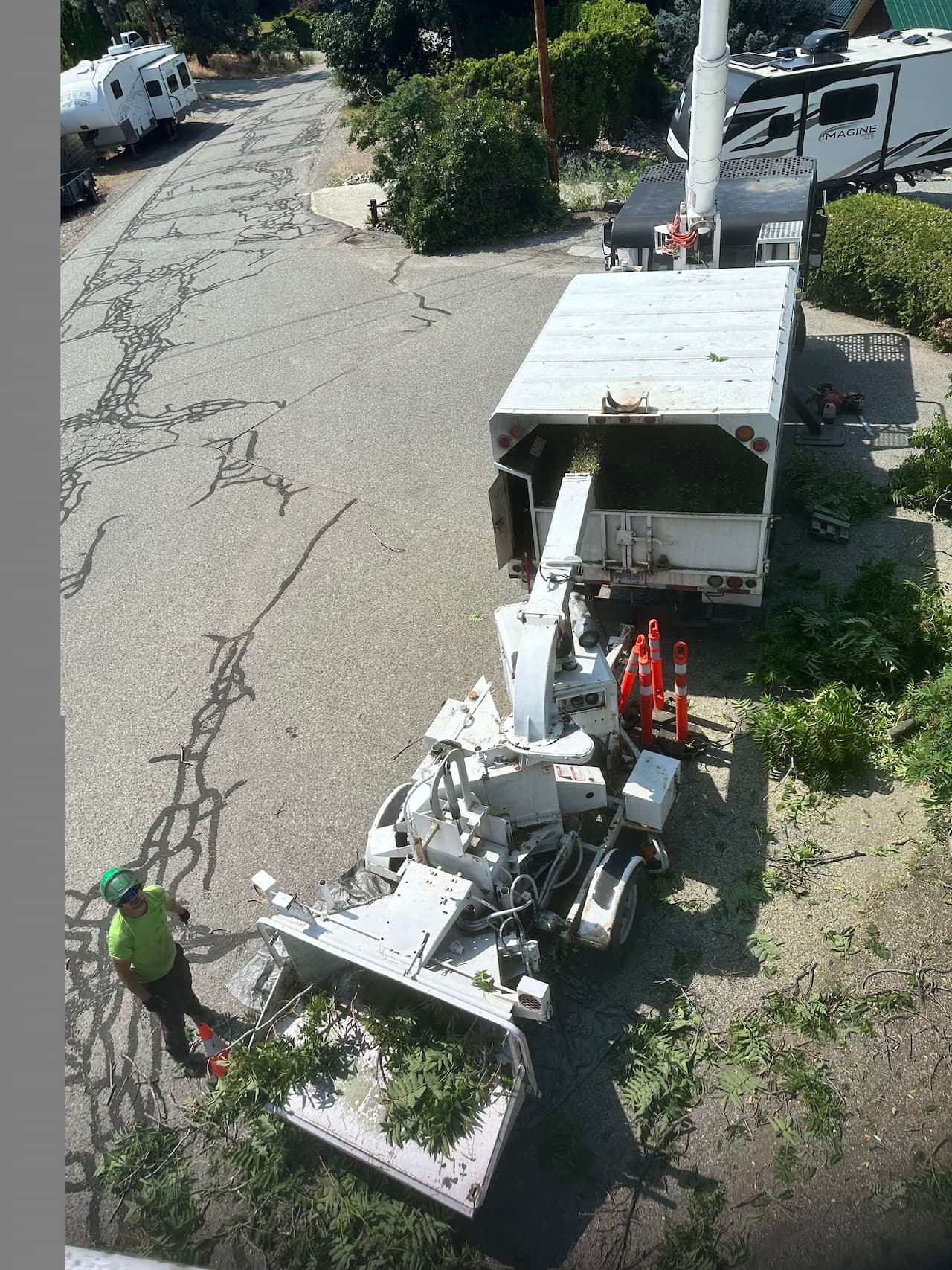
- Discuss parking for chipper and truck, and notify neighbors if needed
- Point out any landscape features to protect, like delicate koi lines or new plantings
Aftercare that makes pruning last
A good prune sets the tree up for several years. Aftercare keeps the momentum. Mulch is the single best investment, a 2 to 3 inch layer out to the dripline where possible, pulled back a few inches from the trunk. Deep, occasional watering beats frequent shallow sprinkles, especially for trees that rely on sprawl rather than taproots. On compacted sites, we may recommend vertical mulching or air spading to add pore space and organic matter.
Inspect cuts over the next seasons. You should see healthy callus, not cracks or sunken, dark tissue. If vigorous watersprouts appear in clusters, that can be normal response. We come back to thin and train the best positioned shoots into the next layer of structure. If you see sudden changes, like late season leaf drop on one sector or boring dust at the base, call. Early intervention can save a lot of crown.
Why we say no to topping and yes to patient shaping
Topping seems like a quick fix. It lowers the height and, on day one, removes the worry. The regrowth tells the truth. Dozens of shoots emerge from weakly attached tissues near each cut, growing fast and tall. Within a few years, the tree is taller than before, but now with high leverage, poor attachments. Decay enters the large topping wounds. We inherit these cases, and the path forward is often a multi year restoration that costs more than the initial topping job saved.
Patient shaping takes longer but keeps the biology on your side. Reduce height by transferring growth to lower laterals with good angles. Thin to admit wind and light. Cable where a union is suspect. Remove a poorly placed tree and replant the right species in the right spot. This is how you keep shade, safety, and value over decades.
Putting it all together
Fine pruning is not a menu item. It is the quiet work that makes the rest of tree care succeed. Tree Pruning & Crown Shaping, Tree Cable and Bracing, FireSmart Tree Services, and even Tree Removal Services and Stump Removal & Grinding all fit into the same ethic. Do the least harm that meets the goal. Use clean cuts and good timing. Respect species and site. When the wind comes up or fire season turns mean, Emergency Tree Services and Dangerous Tree Assessment and Removal are there, but the best outcomes come from the steady work before and after the storm.
If you have a tree that needs a gentler hand, a crown that could carry storms more gracefully, or a property that needs a safer fire profile, start with a Certified Arborist Consultation. We will walk, look, listen, and plan. Then we will do exactly as much as is needed, with tools that stay sharp and eyes that stay on the whole tree.
Ace Tree Services Ltd.
Name: Ace Tree Services Ltd.Address: 4656 Wallace Hill Road, Kelowna, BC
Postal code: V1W 4C2
Phone: 250-212-9593
Website: https://acetree.ca/
Hours:
Monday: 7:00 AM - 5:00 PM
Tuesday: 7:00 AM - 5:00 PM
Wednesday: 7:00 AM - 5:00 PM
Thursday: 7:00 AM - 5:00 PM
Friday: 7:00 AM - 5:00 PM
Saturday: 7:00 AM - 5:00 PM
Sunday: Closed
Open-location code (plus code): RHF8+8G Kelowna, British Columbia, Canada
Map/listing URL: https://www.google.com/maps/place/Ace+Tree+Services+Ltd./@49.8232606,-119.4337283,659m/data=!3m2!1e3!4b1!4m6!3m5!1s0x537d8b1d074815c5:0x450b88afa7a41435!8m2!3d49.8232606!4d-119.4337283!16s%2Fg%2F11ydkpnh22
Embed iframe:
Ace Tree Services Ltd. provides professional tree removal, pruning, stump grinding, emergency response, and arborist consultations for properties in Kelowna and across the Okanagan Valley.
The company works with homes, commercial properties, and municipal settings where tree work needs to be planned carefully around buildings, fences, driveways, landscaping, and other site constraints.
Based in Kelowna, the team is positioned to help nearby neighbourhoods and surrounding Okanagan communities with routine tree care and time-sensitive storm cleanup.
Customers looking for careful tree work often want a crew with certified arborist training, insurance, and a methodical approach to higher-risk removals.
Services also include dangerous tree assessment, cabling and bracing, and wildfire risk reduction tree work for properties that need longer-term planning.
To request a quote or discuss tree care options, call 250-212-9593 or visit https://acetree.ca/.
A public map listing is available to help customers confirm the business location and get directions before a site visit or estimate.
For Kelowna property owners who need pruning, removals, or emergency tree help, a local tree service can make it easier to schedule site-specific recommendations and cleanup.
Popular Questions About Ace Tree Services Ltd.
What services does Ace Tree Services Ltd. provide?Ace Tree Services Ltd. lists tree removal, stump removal and grinding, tree pruning and crown shaping, emergency tree service, arborist consultation, dangerous tree assessment and removal, cabling and bracing, and wildfire risk reduction tree work.
Who does Ace Tree Services Ltd. serve?
The company describes its work as serving homes, businesses, and municipalities in Kelowna and across the Okanagan Valley.
Is emergency tree help available?
Yes. Emergency service is listed for downed or uprooted trees, dangerous tree assessment, stabilization work, and branch cleanup. If a tree is near power lines, the safest first step is to stay clear and contact the utility provider before any tree work begins.
Do I always need a permit to remove a tree?
Not always. Permit requirements can depend on where the tree is located and whether it is near a creek, lake, steep slope, or another protected area. It is best to check local rules for the specific property before removal work starts.
How deep does stump grinding usually go?
Standard stump grinding is typically described as going about 6 to 12 inches below ground level, which is often enough for grass or surface landscaping. Deeper grinding may be possible when site plans call for it.
How much of a tree can be safely removed at one time?
That depends on the species, age, health, and structure of the tree. In practice, good pruning is usually about removing the right limbs for health, clearance, and structure rather than chasing a fixed percentage.
What are common signs that a tree may be dangerous?
Large dead limbs, visible cracks, a new lean, root damage, canopy dieback, or storm-related damage can all be warning signs. Trees near structures deserve extra attention when any of those issues appear.
What is cabling and bracing in tree care?
Cabling and bracing are support systems used to reduce the risk of failure in trees with structural weaknesses that may still be worth preserving. They are generally used to add support, not to replace good assessment and ongoing maintenance.
How do I contact Ace Tree Services Ltd.?
Call 250-212-9593.Website: https://acetree.ca/.
Landmarks Near Kelowna, BC
Downtown KelownaThe downtown core is a practical reference point for lakefront neighbourhoods, mixed-use streets, and central residential properties. If your property is near downtown, tree pruning, removals, and cleanup can be planned around tighter access and nearby structures.
Knox Mountain Park
This well-known park north of downtown is a recognizable landmark for nearby homes and hillside properties. If you are close to this area, ask about tree assessment, trimming, or removal work suited to sloped sites.
Mission Creek Greenway
The greenway runs through several parts of Kelowna and is a useful landmark for nearby residential areas. If your property borders or sits near this corridor, site-specific tree planning is especially important.
Pandosy Village
Pandosy is one of Kelowna’s most recognizable neighbourhoods and a common reference point for south-central properties. If you are nearby, request help for pruning, removals, or storm cleanup around homes and small commercial sites.
Rutland
Rutland is a major east Kelowna neighbourhood with a mix of residential and local commercial properties. If you are located in or near Rutland, tree work can be scheduled for both routine maintenance and urgent situations.
Landmark District
This central business-focused area is a practical landmark for offices, service properties, and nearby residential streets. If your site is near the district, ask about careful tree work around parking, access lanes, and built-up lots.
Kelowna’s North End
The North End sits on the edge of downtown and is a useful reference for nearby homes, industrial sites, and commercial properties. If you are in this part of the city, request tree care based on the layout and constraints of the lot.
Airport District
The Airport District is a recognizable north Kelowna reference point for surrounding properties and access routes. If you are in this area, ask about tree services for residential acreage, commercial sites, or roadside cleanup needs.
Glenmore & Dilworth
These established Kelowna neighbourhoods are useful landmarks for central and north-central service calls. If your property is nearby, pruning and removal work can be tailored to mature trees and established landscapes.
Highway 97 Corridor
Highway 97 is one of the city’s main travel routes and a common way to describe location within Kelowna. If your home or property is just off the corridor, a clear landmark reference can help speed up quote scheduling and site planning.