Structural Support with Tree Cable and Bracing Systems
A healthy tree can still have weak points. Codominant stems with a tight V, long overextended limbs over a driveway, or cavities from an old pruning wound can all add risk without obvious warning. Cabling and bracing give us a way to lower the chance of failure while keeping a valued tree in place. Done correctly, these systems share load between parts of the crown, reinforce weak unions, and buy time for roots and wood to strengthen. Done poorly, they create new problems and a false sense of security.
This is a craft that mixes physics, wood anatomy, and judgment. I have installed hundreds of structural systems over the past two decades, from discreet dynamic cables hidden high in a Japanese maple to rod-and-cable complexes inside a century-old oak that straddled a property line. The right approach depends on the tree’s species, defects, exposure, and the client’s tolerance for risk and maintenance.
What cabling can and cannot do
Cabling and bracing are not magic or permanent. They reduce the likelihood of certain failure modes, they do not eliminate them. A cable cannot compensate for a decayed root system or stop a tree from uprooting in saturated soils. Bracing rods do not reverse decay inside a trunk. Support systems are best for trees with localized structural weaknesses but otherwise sound root plates and acceptable residual wall thickness.
I like to frame it this way. Cables redistribute load to change the way a tree moves under wind and snow. Braces prevent crack propagation at a union that wants to pull apart. Props and guys can hold a leaning or heritage limb that would otherwise have to be removed. Each is a tool with a narrow purpose. When we try to stretch that purpose, failures follow.
How an arborist decides if your tree is a candidate
Any decision to install a structural system should start with a Certified Arborist Consultation and a formal risk assessment. We use visual inspection, sounding with a mallet, resistograph readings when warranted, and sometimes sonic tomography on heritage trees. The goal is to understand the defect, quantify the likelihood of failure under typical loads, and weigh consequences to people and targets.
I look for the path of load through the crown. Codominant leaders with included bark often show ribs of reaction wood along the union. A long horizontal limb may sag more on warm afternoons, a tell that fiber buckling has begun. Decay columns down the pith change how a bolt will hold. Species matter too. Silver maple grows fast with relatively brittle wood and often benefits from dynamic cabling to soften shock loads. White oak holds hardware beautifully and responds well to through-bolted rods when a crack shows.
Target rating matters as much as defect severity. A weak union over a quiet back meadow may be fine with light pruning and monitoring. The same union over a high-traffic sidewalk can require aggressive mitigation or Dangerous Tree Assessment and Removal. We document these judgments in writing so owners can align tree work with their risk tolerance and insurance requirements.
Common signs that point toward structural support
- Codominant stems with a tight V and included bark, especially when the diameter of either stem exceeds 8 inches.
- A long, heavy lateral limb growing over a structure or driveway with visible sag or crack lines near the union.
- Previous storm damage that left partial fractures or hinge wood torn near a major attachment point.
- Cavities or decay near a union that still has adequate residual wall thickness to hold hardware.
- A valued heritage branch where pruning for weight reduction alone would remove too much live tissue.
Choosing between static and dynamic cabling
Two broad philosophies guide cable selection. Static systems use extra high strength steel cable and hard attachments. Dynamic systems use synthetic rope with energy absorbers and flexible anchors. Neither is universally better, they solve different problems.
Static steel excels where movement must be limited. I use it on codominant leaders that show active separation or a hinge crack. The hardware arrests further opening under wind load. It also suits situations where we expect heavy snow or ice. In a wet, coastal climate, galvanized EHS steel holds up very well, often for decades if inspected and adjusted as the tree grows.
Dynamic systems shine when the goal is to support but still allow some sway. They are common in Europe and increasingly used here on species prone to shock loading. The rope, typically UV-stable polypropylene with built-in shock absorbers, spreads force across the attachment and reduces peak loading. On a beech or birch with high aesthetic value, a well-placed dynamic system can be practically invisible from the ground, and it will not require drilling. That matters for certain trees that compartmentalize poorly around wounds.
I have also combined the two on complex trees. One old copper beech had a dying parent limb that sheltered a patio. We installed a static backup cable as a failsafe high in the crown, then a lower dynamic line to share load under ordinary wind. The beech kept its graceful movement without the alarming lurches that had shown up after a heavy snow year.
Bracing rods, bolts, and when to drill
Bracing addresses cracks and weak unions from the inside. We install threaded steel rods through the union at right angles to the crack to keep the pieces from pulling apart. In a classic codominant oak, I will place one rod just below the union at a depth that captures sound wood on both sides, then a second rod 6 to 12 inches above it if the union is tall. The rod diameter ranges from 3/8 inch on small trees up to 3/4 inch or more on large, high-consequence specimens.
Through-bolts with washers and nuts on both ends provide reliable clamping and long-term adjustability. Lag-threaded bolts have their place in smaller diameter limbs where a through-hole would remove too much material, but they rely on a certain amount of sound wood to hold and are more sensitive to installation technique. Tightening is not a one-and-done task. As the tree grows and the union changes under load, nuts should be checked and, if needed, adjusted.
Whenever we drill, we accept a wound. The standard of care is to keep holes as small and as few as practical, use sharp bits, avoid drilling through decay pockets that will not hold a thread, and position hardware so the tree can overgrow and protect it. A clean, perpendicular hole through sound wood with proper washers spreads load and reduces crushing of fibers under the nut.
Hardware and standards that keep you safe
Reputable arborists follow industry standards because the math has already been done. The ANSI A300 Part 3 standard for Supplemental Support Systems sets out placement, sizing, and installation practices, and the companion BMPs walk through real scenarios. Following those documents, typical cable placement is about two thirds of the distance from the defect to the tip of the crown or limb we are supporting. That achieves a favorable lever arm without overly restricting movement.
EHS galvanized steel cable in sizes from 1/8 to 3/8 inch covers most residential trees. Dead-end grips or wire rope clips form terminations, and thimbles prevent wear where the cable wraps hardware. Rated eye bolts or lag eyes secure the cable to the tree. In dynamic systems, high-quality, UV-stable rope with rated connectors and abrasion sleeves protect the bark and cambium. Every component should carry a safe working load that exceeds the expected peak forces with a healthy margin, often a factor of five or more.
Corrosion protection is not just a nice to have. Near the ocean, I specify stainless hardware or at least hot-dipped galvanized components for exposed nuts and washers. In drier interiors, standard galvanization lasts longer than most clients will own their homes. Regardless of material, we track installation dates, locations, and specs so inspections can verify that what we installed is still the right system for the current size of the tree.
Installation details that separate good from mediocre
The difference between a system you forget about for 10 years and one that fails in the first storm usually lives in details you never see from the ground. Small errors compound.
Height and alignment matter. Place cables as high as practical, roughly at two thirds of the distance from the defect to the tips of supported limbs. Align attachment points so cables pull along the axis of expected load. If the supported leaders form a triangle, consider a triangular cabling pattern that shares load between all three, rather than two independent cables that may fight each other.
Pre-tensioning is not arbitrary. Static cables should be snug without removing all natural movement. I aim for a slight droop, enough that in light wind the leaders still sway independently. Over-tightening transfers shock directly into the hardware and the wood fibers around the anchors, increasing the risk of fiber crushing and brittle failure.
Drilling technique saves trees. Use clean bits, back your way through to avoid tearing exit holes, and keep holes level and square. Deburr and seat washers so no sharp edges cut into the bark as the tree grows. On large trees, saddle cuts can seat washers flush without compromising too much tissue.
Pruning and cabling are siblings. Most successful installations include Tree Pruning & Crown Shaping to reduce end weight or shorten lever arms. I commonly remove 10 to 20 percent of foliage in a targeted way on the most stressed leaders. Less is more. Over-thinning destabilizes the crown and can increase wind penetration, a recipe for failures elsewhere. Weight reduction should be strategic, focused on moving the center of mass closer to the union.
Maintenance, inspections, and realistic service life
Support systems need eyes on them. An annual inspection, plus a check after major wind or ice events, is the baseline. I look for crushed bark at attachment points, cable tension changes, cracked thimbles, and any https://privatebin.net/?50dd9ba42a5d0714#Dmy4zdxAN2SDjQiTzyUAoH1YANSfBJU8MfEt2x1SyinJ sign that a lag is pulling or a rod is bending. For dynamic systems, abrasion sleeves can creep, and UV exposure ages rope faster on south and west exposures.
Hardware lifespan varies with environment, species growth rate, and installation quality. In temperate, inland settings, steel cables often serve 15 to 25 years before replacement or up-sizing is warranted. Dynamic rope systems typically have manufacturer guidance in the 8 to 12 year range for replacement, sometimes shorter in high UV zones. Trees grow, so clearances close and bark can begin to envelop hardware. We install spacers or adjust anchors to avoid girdling.
If you bought a home with an existing cable, get it assessed. I have found homeowner-installed systems strung like dog leashes between trees, and I have removed rusted cables so loose they offered no support. A quick Certified Arborist Consultation is inexpensive insurance.
When cabling is not the right answer
There are limits. A trunk with advanced decay that leaves less than 30 percent residual wall thickness around a central column is a poor candidate for drilling or for trusting with high loads. A root plate compromised by fungus or backfilled grading will not hold under load, cable or no cable. If the defect sits over high-occupancy targets and the consequences are severe, mitigation must match that reality.
This is where Dangerous Tree Assessment and Removal enters the conversation. Removing a compromised tree and starting fresh is sometimes the best, most honest recommendation. Clients often appreciate forthright guidance when they hear the reasoning. If removal is chosen, plan for Tree Removal Services that protect nearby structures and utilities, followed by Stump Removal & Grinding to allow replanting. The replanting step is part of a long view, choosing species and siting that avoid repeat problems.
Cabling or removal, a practical decision guide
- Choose cabling when the defect is localized, the root system is sound, and consequences of failure are moderate to low with the support system in place.
- Choose removal when decay or root instability is widespread, targets are high-value and unavoidable, or the system would require complex, high-maintenance hardware with marginal benefit.
- Choose a hybrid when a limited period of support will allow staged pruning, crown retraining, or time to establish a replacement tree before removal.
- Defer action only when documented monitoring shows low likelihood of failure and the owner accepts the residual risk.
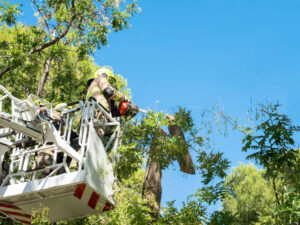
- Escalate to Emergency Tree Services immediately after storm damage that creates hanging branches, fresh cracks, or sudden lean, before anyone walks or parks under the tree.
Integrating FireSmart Tree Services without compromising structure
Wildfire risk management intersects with structural support, but not in the way many expect. FireSmart Tree Services focus on fuel reduction, ladder fuel removal, spacing, and maintaining defensible space around structures. Cabling does not reduce fuels. However, a well-pruned, structurally supported tree is easier to treat for FireSmart goals. Strategic crown thinning to remove deadwood and reduce ladder fuels can be done without gutting the architecture that cables are meant to preserve.
Be aware that fire can weaken hardware and the surrounding wood. In regions with seasonal wildfire, post-event inspections should include any supported trees. Heat can anneal steel components, and even when leaves look green, cambium injury around anchors may have progressed unseen.
Costs, timelines, and what to expect on site
Pricing varies with access, tree size, number of anchors, and the mix of cabling and bracing. As a rough guide from recent residential work, a simple two-point static cable on a medium maple runs a few hundred dollars per cable when installed as part of a pruning visit. Complex systems with multiple cables and through-bolted rods on large oaks often land in the low thousands. Add the cost of Tree Pruning & Crown Shaping which is typically integral to a good outcome.
Most installations take a half day to a full day with a two-person crew and a bucket truck or climbing gear. Expect minor bark disturbance at anchors and neat, purposeful cuts in the crown where weight reduction is indicated. We leave you with a diagram of anchor locations, hardware specs, and inspection intervals. That record matters for future owners and for any insurance questions that may arise.
A case from the field
A 110-year-old white oak sat between two homes, its codominant leaders forming a tall, elegant canopy over both yards. Fifteen years ago one leader developed a hairline crack at the union after a wet snow. Removal would have changed both properties and brought a crane into tight alleys. We braced the union with two 5/8 inch through-rods staggered 10 inches apart, then installed a triangular pattern of 1/4 inch EHS steel cables at two thirds crown height tying the three primary leaders together. We paired that with careful end-weight reduction on the most extended limbs, no more than 15 percent foliage removed on any one leader.
The homeowner agreed to annual inspections and called us after major wind events. Last fall, after a week of heavy rain and a windstorm, we tightened one nut a quarter turn and noted slight bark inclusion beginning around a lag eye on a secondary support. We added a spacer to avoid girdling and updated the inspection record. The tree is still in place, shading both homes, and the neighbors share the modest cost as part of a written plan. That level of follow-through is why the system has served longer than a decade without drama.
Safety, liability, and the value of professional oversight
There is real risk in climbing, drilling, and tensioning above your driveway. A professional crew brings rigging expertise, fall protection, and the right tools. More important, a Certified Arborist can defend the plan. If a supported tree fails and causes damage, documentation of appropriate standards, inspections, and maintenance can matter in a claims process. Cutting corners with cheap hardware or skipping inspections shifts risk back onto the owner.
Where permits apply, particularly for heritage trees or street trees, a professional can coordinate with the municipality. Some cities require a permit not only for Tree Removal Services but also for significant structural modifications. Good communication with neighbors also avoids disputes, especially when supports cross property lines or protect targets on both sides.
How pruning strategy and support interact over time
A support system that never changes while the tree keeps growing is a mismatch. With every growth ring, leverage changes. I plan a three to five year pruning cycle on supported trees. The priorities are to keep end weight in check, maintain clearance around cables and anchors, and retrain the crown so new attachments develop where they can share load naturally. In some cases, staged reduction of a risky leader allows us to remove a cable entirely after a few cycles.
Avoid lion-tailing, the over-thinning of interior foliage that leaves tufts at branch ends. It looks tidy on installation day, then shifts loads to the tips and invites snap-out failures later. Focus instead on selective thinning that preserves the branch’s taper and distributes foliage evenly along its length.
Emergency scenarios and what to do after a storm
Storms do not respect our calendars. If a cable has snapped or a branch is now hanging, keep people and cars out of the drop zone and call for Emergency Tree Services. Do not attempt to reattach a cable under tension from a ladder. A crew will secure the area, assess whether the remaining system has integrity, and either make safe temporary repairs or dismantle compromised hardware before it causes more damage.
When partial failures expose new information, like a hidden decay pocket, we re-evaluate the entire plan. Sometimes that means stepping up to additional bracing. Sometimes it means it is time to remove and replant. That is not a failure of the original decision, it is adaptive management in a living system.
Connecting structural support to the rest of your tree care
Supplemental support is one chapter, not the whole story. Soil health, irrigation, and pest management affect how well wood grows around hardware and how resilient a tree remains under wind. Mulch properly, avoid soil compaction over the root zone, and address pests early, especially borers and decay fungi that target stressed wood.
If removal enters the plan now or later, close the loop. Schedule Stump Removal & Grinding so roots do not sprout and so you can replant in a timely way. Match new species to the site, and plan structural pruning from year one so codominant leaders are corrected early. The best cable in the world is the one you never need because a young tree was guided into a strong architecture.
Getting started the right way
Book a Certified Arborist Consultation and ask for a written assessment that covers defects, targets, recommended support type, pruning, and an inspection schedule. A thoughtful arborist will talk through trade-offs, costs, and maintenance so you can decide with clear eyes. If the advice points to Dangerous Tree Assessment and Removal, take that seriously. If cabling and bracing are appropriate, you will have a practical plan that preserves shade, habitat, and the character of your landscape while managing risk.
Trees give back for decades. With the right structural support where needed, and with honest judgment about limits, you can keep mature canopy on your property safely. That is the heart of good arboriculture, balancing biology, physics, and the way we live around trees.
Ace Tree Services Ltd.
Name: Ace Tree Services Ltd.Address: 4656 Wallace Hill Road, Kelowna, BC
Postal code: V1W 4C2
Phone: 250-212-9593
Website: https://acetree.ca/
Hours:
Monday: 7:00 AM - 5:00 PM
Tuesday: 7:00 AM - 5:00 PM
Wednesday: 7:00 AM - 5:00 PM
Thursday: 7:00 AM - 5:00 PM
Friday: 7:00 AM - 5:00 PM
Saturday: 7:00 AM - 5:00 PM
Sunday: Closed
Open-location code (plus code): RHF8+8G Kelowna, British Columbia, Canada
Map/listing URL: https://www.google.com/maps/place/Ace+Tree+Services+Ltd./@49.8232606,-119.4337283,659m/data=!3m2!1e3!4b1!4m6!3m5!1s0x537d8b1d074815c5:0x450b88afa7a41435!8m2!3d49.8232606!4d-119.4337283!16s%2Fg%2F11ydkpnh22
Embed iframe:
"@context": "https://schema.org", "@type": "HomeAndConstructionBusiness", "name": "Ace Tree Services Ltd.", "url": "https://acetree.ca/", "telephone": "250-212-9593", "address": "@type": "PostalAddress", "streetAddress": "4656 Wallace Hill Road", "addressLocality": "Kelowna", "addressRegion": "BC", "addressCountry": "CA" , "openingHoursSpecification": [ "@type": "OpeningHoursSpecification", "dayOfWeek": "https://schema.org/Monday", "opens": "07:00", "closes": "17:00" , "@type": "OpeningHoursSpecification", "dayOfWeek": "https://schema.org/Tuesday", "opens": "07:00", "closes": "17:00" , "@type": "OpeningHoursSpecification", "dayOfWeek": "https://schema.org/Wednesday", "opens": "07:00", "closes": "17:00" , "@type": "OpeningHoursSpecification", "dayOfWeek": "https://schema.org/Thursday", "opens": "07:00", "closes": "17:00" , "@type": "OpeningHoursSpecification", "dayOfWeek": "https://schema.org/Friday", "opens": "07:00", "closes": "17:00" ], "geo": "@type": "GeoCoordinates", "latitude": 49.8232606, "longitude": -119.4337283 , "hasMap": "https://www.google.com/maps/place/Ace+Tree+Services+Ltd./@49.8232606,-119.4337283,659m/data=!3m2!1e3!4b1!4m6!3m5!1s0x537d8b1d074815c5:0x450b88afa7a41435!8m2!3d49.8232606!4d-119.4337283!16s%2Fg%2F11ydkpnh22"
Ace Tree Services Ltd. provides professional tree removal, pruning, stump grinding, emergency response, and arborist consultations for properties in Kelowna and across the Okanagan Valley.
The company works with homes, commercial properties, and municipal settings where tree work needs to be planned carefully around buildings, fences, driveways, landscaping, and other site constraints.
Based in Kelowna, the team is positioned to help nearby neighbourhoods and surrounding Okanagan communities with routine tree care and time-sensitive storm cleanup.
Customers looking for careful tree work often want a crew with certified arborist training, insurance, and a methodical approach to higher-risk removals.
Services also include dangerous tree assessment, cabling and bracing, and wildfire risk reduction tree work for properties that need longer-term planning.
To request a quote or discuss tree care options, call 250-212-9593 or visit https://acetree.ca/.
A public map listing is available to help customers confirm the business location and get directions before a site visit or estimate.
For Kelowna property owners who need pruning, removals, or emergency tree help, a local tree service can make it easier to schedule site-specific recommendations and cleanup.
Popular Questions About Ace Tree Services Ltd.
What services does Ace Tree Services Ltd. provide?Ace Tree Services Ltd. lists tree removal, stump removal and grinding, tree pruning and crown shaping, emergency tree service, arborist consultation, dangerous tree assessment and removal, cabling and bracing, and wildfire risk reduction tree work.
Who does Ace Tree Services Ltd. serve?
The company describes its work as serving homes, businesses, and municipalities in Kelowna and across the Okanagan Valley.
Is emergency tree help available?
Yes. Emergency service is listed for downed or uprooted trees, dangerous tree assessment, stabilization work, and branch cleanup. If a tree is near power lines, the safest first step is to stay clear and contact the utility provider before any tree work begins.
Do I always need a permit to remove a tree?
Not always. Permit requirements can depend on where the tree is located and whether it is near a creek, lake, steep slope, or another protected area. It is best to check local rules for the specific property before removal work starts.
How deep does stump grinding usually go?
Standard stump grinding is typically described as going about 6 to 12 inches below ground level, which is often enough for grass or surface landscaping. Deeper grinding may be possible when site plans call for it.
How much of a tree can be safely removed at one time?
That depends on the species, age, health, and structure of the tree. In practice, good pruning is usually about removing the right limbs for health, clearance, and structure rather than chasing a fixed percentage.
What are common signs that a tree may be dangerous?
Large dead limbs, visible cracks, a new lean, root damage, canopy dieback, or storm-related damage can all be warning signs. Trees near structures deserve extra attention when any of those issues appear.
What is cabling and bracing in tree care?
Cabling and bracing are support systems used to reduce the risk of failure in trees with structural weaknesses that may still be worth preserving. They are generally used to add support, not to replace good assessment and ongoing maintenance.
How do I contact Ace Tree Services Ltd.?
Call 250-212-9593.Website: https://acetree.ca/.
Landmarks Near Kelowna, BC
Downtown KelownaThe downtown core is a practical reference point for lakefront neighbourhoods, mixed-use streets, and central residential properties. If your property is near downtown, tree pruning, removals, and cleanup can be planned around tighter access and nearby structures.
Knox Mountain Park
This well-known park north of downtown is a recognizable landmark for nearby homes and hillside properties. If you are close to this area, ask about tree assessment, trimming, or removal work suited to sloped sites.
Mission Creek Greenway
The greenway runs through several parts of Kelowna and is a useful landmark for nearby residential areas. If your property borders or sits near this corridor, site-specific tree planning is especially important.
Pandosy Village
Pandosy is one of Kelowna’s most recognizable neighbourhoods and a common reference point for south-central properties. If you are nearby, request help for pruning, removals, or storm cleanup around homes and small commercial sites.
Rutland
Rutland is a major east Kelowna neighbourhood with a mix of residential and local commercial properties. If you are located in or near Rutland, tree work can be scheduled for both routine maintenance and urgent situations.
Landmark District
This central business-focused area is a practical landmark for offices, service properties, and nearby residential streets. If your site is near the district, ask about careful tree work around parking, access lanes, and built-up lots.
Kelowna’s North End
The North End sits on the edge of downtown and is a useful reference for nearby homes, industrial sites, and commercial properties. If you are in this part of the city, request tree care based on the layout and constraints of the lot.
Airport District
The Airport District is a recognizable north Kelowna reference point for surrounding properties and access routes. If you are in this area, ask about tree services for residential acreage, commercial sites, or roadside cleanup needs.
Glenmore & Dilworth
These established Kelowna neighbourhoods are useful landmarks for central and north-central service calls. If your property is nearby, pruning and removal work can be tailored to mature trees and established landscapes.
Highway 97 Corridor
Highway 97 is one of the city’s main travel routes and a common way to describe location within Kelowna. If your home or property is just off the corridor, a clear landmark reference can help speed up quote scheduling and site planning.